Sometimes, walking through the grasslands to block, close my eyes and try to imagine the city before the dictatorship. I am assailed by the sweet feeling of life flowing slowly between streets and alleys dotted with small houses of different styles, with vegetable gardens, close to the center, forming a link between town and country.
Then one day came to power Ceauşescu and its bulldozers and, like any self-respecting regime, we chose to make a clean sweep of the past. The goal was to build 'new man' socialist. Yet in words Nicolae showed concern for the collective memory of his country, saying: "We have a past of which we can be proud of." In practice, however, to build the current Parliament House, the second largest building in the world after the Pentagon, former President of Romania has about 40,000 homes razed to the ground pretty, one-sixth of the city.
Instead stretches of buildings with 10 floors, rarely of colors other than gray, which appear to poisonous mushrooms erupted after a particularly acid rain. Only block of the city's main boulevard are sometimes embellished with ornaments nouveau or baroque real neo-socialist. The historic districts survived the massacre cultural Lipscani for example, are a small part of the urban fabric, and until less than a hundred years ago were the norm.
The cultural suicide has hit the country far and wide. The plans, fortunately thwarted by the collapse of the wall were to halve by 2000 the number of villages. Before 89 to 29 cities was changed face completely, while other's work 'restyling' and never started corporating completed.
At Giurgiu, a small town on the banks of the Danube the border with Bulgaria, the center has saved only one tower. When I asked what she looked like the city in the past, some peers I could respond. Giurgiu now looks like a sad maze of gray square 4-story buildings, which stretch all the perimeter of the city.
Obviously I am not been spared the houses of worship. One example to grasp the magnitude of the charge paranoid: the Monastery of Prince Mihai was moved nearly 300 meters, to hide it from view.
Such a systematic attempt to demolish centuries of culture creates more confusion and modernity, in its corniness, quickly took root on a cultural terrain devastated. A few rules by capitalism and easy profits for the usual shady characters, is completing the work begun half a century ago.
In Romania it was necessary that everything changes so that everything remained as it was. The urban landscape has not had time to cicattrizzare the wounds of a mad Soviet utopia, that the bulldozers were already at work to raise other bloc, made in haste and without regard to quality, as misplaced and hypocritical in their claim to elegance that flows kitsch.
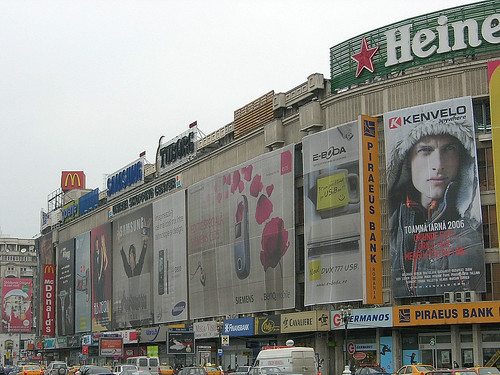
The pillars of the new life of the Romanian cities have become shopping malls. Unirii Square, downtown della Bucarest di Ceauşescu, dove uno shopping mall ha preso il posto degli ex-magazzini di stato perennemente vuoti, gli enormi cartelloni pubblicitari disorientano. Come recita un adesivo comparso in metropolitana dopo il primo maggio: “i comunisti di ieri, capitalisti di oggi”.


0 comments:
Post a Comment